






Forestier's Historic Connections
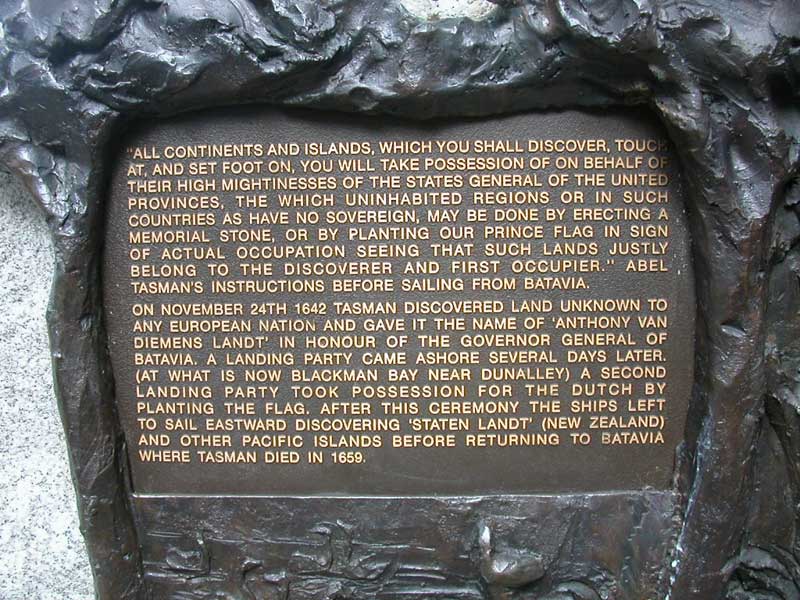
Though many modern day travellers are not familiar with Forestier Peninsula, such has not been the case with Tasmania's pre-colonial visitors. Dutch explorer spent two weeks exploring the shores of southern Tasmania in November and December 1842. On 3rd December, as he was leaving the area, Tasman made for a bay at the northern end of the Peninsula, but the sea was too rough to allow a landing. The carpenter, Peter Jacobsen, volunteered to swim ashore with a pole on which was Prince Frederick Henry's flag, which he planted on the shore. Thus Tasman took possession of Tasmania for the Dutch on Forestier Peninsula at what he called Frederick Henry Bay, which is todsay known as Tasman Bay.
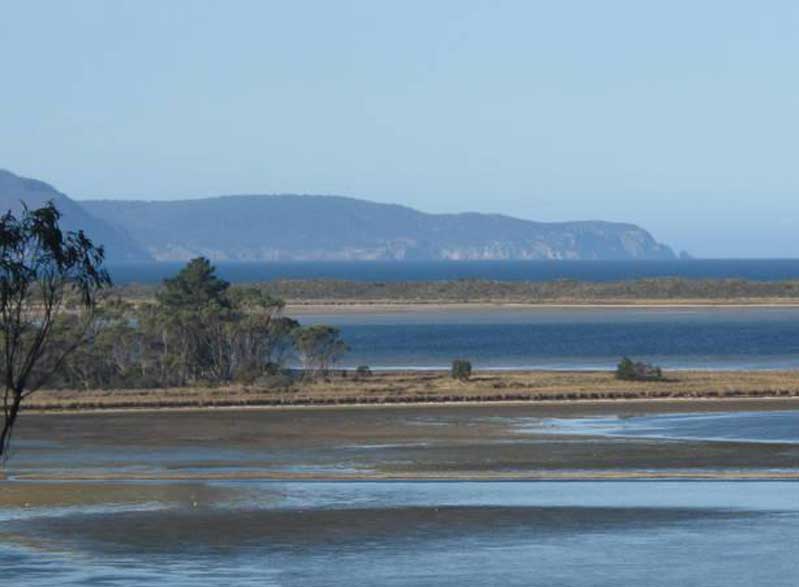
Tasman had named another large bay close by 'Blackman Bay', because of the presence of Aboriginal people. British explorer Tobias Furneux surveyed the south east corner of Tasmania in March 1772, but mistook Blackman Bay for Frederick Henry Bay. Furneaux's charts were used to prepare the Admiralty charts of today, which is why the name still applies to the wrong bay. It wasn't until French explorer Nicolas Baudin follows in his footsteps in February 1802, however, that the peninsula received its name. Baudin named it in honour of Henry Verdean Forestier (1755-1806), the French Minister for the Navy and Administration.
Nearby Cape Paul Lamanon recalls the visit of another European explorer. It is thought to have been named by Marion Du Fresne in March 1772 after Chevalier Paul Lamanon, a naturalist and philosopher. Lamanon would later sail from Brest, in August, 1785, with French explorer la Perouse in the frigates Boussole and Astrolabe. Lamanon would have been present at Botany Bay near Sydney in January 1788 when the First Fleet, sent by the British government to establish the penal colony of New South Wales, arrived during the French expedition's sojourn there. The expedition left Botany Bay a few weeks later, never to be heard of again.
A monument on Cape Paul Lamanon marks the spot where Peter Jacobsen came ashore. As it is virtually inaccessible by anything other than boat, a convenient substitute stands in the town of Dunalley.
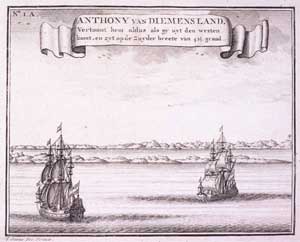
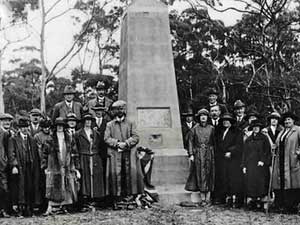 Unveiling of the Tasman Monument, Tasman Bay, 1923. Built by the Royal Society of Tasmania to commemorate Abel Tasman's landing on the Forestier Peninsula in 1642. The monument on Cape Paul Lamanon which marks the spot where Peter Jacobsen came ashore.