

Exploration: Marion du Fresne
 The beginnings of French voyages to the coasts of Australia date back to Jean Binot Paulmier de Gonneville in 1504. He thought, after experiencing a violent storm near the Cape of Good Hope, that he had chanced on the fabled Terra Australis Incognita, a vast southern land mass long postulated as a necessary balance to the continents in the northern hemisphere. Thereafter called 'Gonneville Land' by the French, it became a focus for their maritime aspirations in the region and in 1738 Bouvet de Lozier set out in search of it but found only the barren island that now bears his name.
In 1766 the British navy sent two ships under Wallis and Carteret to the south Pacific in search of the fabled southern continent, and the French despatched Chevalier Louis de Bougainville with the same intention just three months later. While the French and the British found many islands in the Pacific, including Tahiti and Pitcairn, neither found the southern continent. The closest Bougainville came to Terra Australis was when he encountered the Great Barrier Reef adjacent to present-day Cooktown in far north Queensland. On his return home in 1769 Bougainville published an account entitled A Voyage Round The World, that increased French interest in the Pacific.
In 1771, two expeditions left Ile de France (Mauritius) for the Indian Ocean in search of Gonneville's Land. One, led by Marc-Joseph Marion du Fresne, sailed to Van Diemen's Land (Tasmania) and as far as New Zealand, alerting France to their worth though as the names suggest, both had been earlier discovered by the Dutch, in this case by Abel Tasman. The other, a two-ship expedition was led by Y.J. de Kerguelen and it included as second in command, Francois Alesne de St Allouarn. The ships separated and Kerguelen, upon discovering what he thought to be Gonneville's Land, hurried home to announce the discovery of what he called France Australe.
Later, it proved to be a barren island that now bears his name. In the meantime St Alouarn in Le Gros Ventre continued the search for Gonneville's Land. Unsuccessful, he then made for the coast of New Holland, and in landing on Dirk Hartog Island at Dampier's Shark Bay, Saint Alouarn annexed the coast for France in March 1772.
Du Fresne sailed from France on the Mascurin in 1771 with the intention of returning Ahu-toru, the Tahitian whom Bougainville had taken to France in 1769. However during Ahu-toru's stay on Mauritius he contracted smallpox and died three weeks out to sea. du Fresne decided to return to the Cape of Good Hope for provisions and then continue on search of the Great Southern Land with his ship the Mascurin and the warship Marquis de Castries.
On 22 January, 1772 he discovered the Arid Islands, later to be renamed the Crozet Islands, after du Fresne's second-in-command, Julien Crozet, and on 3 March he sighted Van Diemen's Land. They followed Tasman's route and anchored in what they believed to be Fredrick Henry Bay. However, the coastline at the time had not been fully explored and it is now believed to be Blackmans Bay where they anchored, went ashore and claimed Van Diemen's Land for France.
An act of possession took place on 5 March 1772, just 14 days before fellow Frenchman St Allouarn took possession of a part of mainland Australia whilst at Shark Bay on the Western Australian coast. Marion du Fresne's party were the first Frenchmen to make contact with the Tasmanian Aborigines and the first Europeans to set foot there since Tasman. Du Fresne sailed on to New Zealand anchored his ships, Marquis de Castries and Mascarin, in the Bay of Islands from May to July 1772. Relations with Maori deteriorated and Marion du Fresne and others of his company were killed. The survivors retreated to Mauritius.
Marion Bay
17.2.1802, Freycinet. Named after Capt. Marion Du Fresne, French navigator and member of Baudin's expedition.
Cape Paul Lamanon
Possibly named by Marion Du Fresne after Chevalier Paul Lamanon, a naturalist and philosopher on his expedition's team. Lamanon would later sail from Brest, in August, 1785, with French explorer la Perouse in the frigates Boussole and Astrolabe. Part of Bruni D'Entrecasteaux's mission in sailing the shores of Australia in 1792 was to find out what had happened to la Perouse who had disappeared without trace after leaving Botany Bay in 1788.

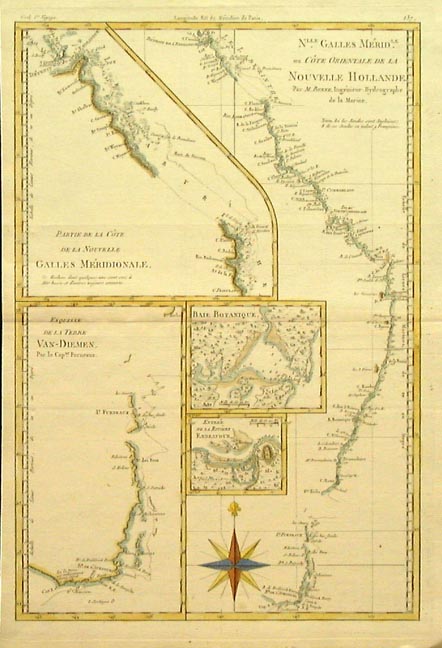
Click to enlarge
Nlle Galles Méridionale ou Cote Orientale De La Nouvelle Hollande. Par. M.Bonne, Ingénieur-Hydrographe de la Marine." - Paris. 1787-1788.
This finely engraved copper plate is divided into 5 separate charts based on a combination of Marion du Fresne's exploration of the coast of Tasmania from Furneaux Island down to Maria Island and Adventure Bay, Furneaux's exploration of the east coast of Tasmania and James Cook's exploration of the mainland's east coast.