

Ross Bridge
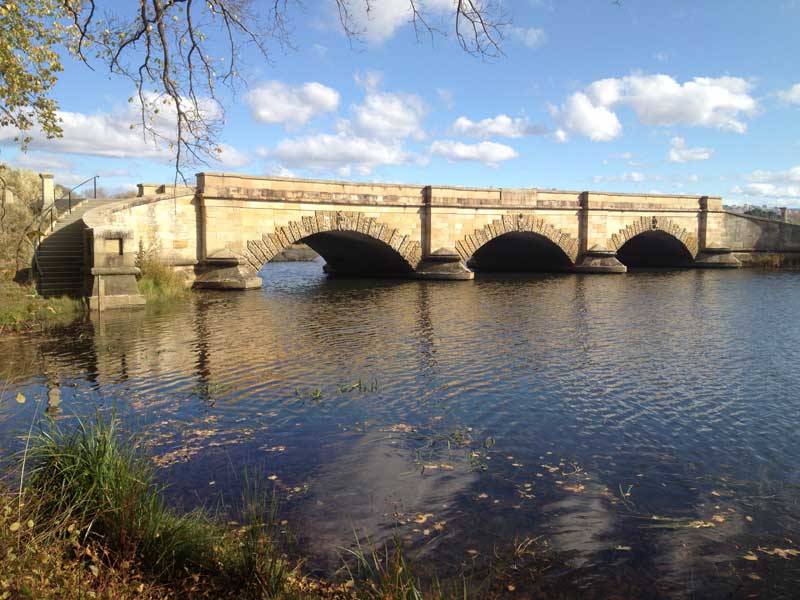
Four years in construction and built of stone quarried locally by convicts and completed in 1836, Ross Bridge, across the Macquarie river at Ross, is unquestionably one of the most picturesque and unusual bridges in Australia.
The ornate carvings on Australia's third oldest bridge are the work of Englishman Daniel Herbert, who came to Van Diemen's Land in December 1827 a convicted highway robber. He continued to live in Ross and died here a free man 1868 - he was buried in the local cemetery on a hill not far from the bridge - and he would have thanked Ross Bridge for his freedom, for it was his work on its construction that gained him a pardon and his release. James Colbeck, another stonemason who worked alongside Herbert, also received a pardon for his work on the bridge.
The work was completed in 58 weeks under the superintendence of Capt. William Turner, 50th Queens Own Regiment of Foot, Commandant of the convict station at Ross. The performance of this workforce, as regards both quality and efficiency, must be considered unique in the history of convict labour in Australia. It is a rare and fortuitous occurrence when a team of leaders consisting of members of such diverse backgrounds emerges to provide an example of superb trade skills and inspirational leadership.
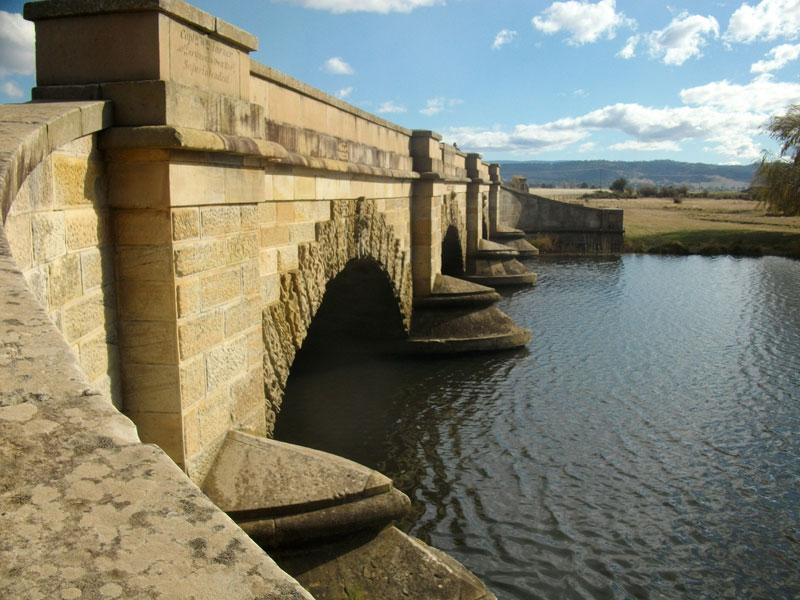
The bridge design is credited to the Government's Civil Engineer, John Lee Archer, as a replacement for an earlier wooden structure that had fallen into disrepair. Archer's plan was for a freestone bridge built for "beauty and durability". His design was for a solid stone structure with three symmetrical arches. A curved stone staircase at each end of the bridge goes down to the river, and chain linked stone pillars lead to the bridge on both sides of the road at each end of the bridge. Archer was the first Colonial Architect and Engineer in Tasmania, designer and builder of a number of outstanding buildings (Ordnance Store, Salamanca Place, Customs House, St. Johns Church Newtown, bridges in Hobart, and lighthouses (Iron Pot and Cape Bruny).
Stone and timber for use in the bridge's construction was readied but a delay in the commencement of the bridge's construction prompted Gov. Arthur to send Divisional Jorgen Jorgenson and six constables to Ross to investigate. It appears that some of the materials prepared for the construction of the bridge had been used in the building of a number of houses at Ross as a result of dealing with settlers and the supervisor of the work.
Work on the bridge finally commenced in 1833. The main credit for its construction goes to convicts Daniel Herbert and James Colbeck. As overseers of the workforce, they laid all the stones and Herbert did most of the carving. The bridge, as it stands today, 170 years after its festive opening, shows remarkably little wear and tear. Founded on a rock plate, its foundations have not moved. The joints in the stonework are of the highest order of accuracy and show no cracks to speak of. In 1976/77 the roadway was reconstructed and provided with an under-floor elastomeric seal and drainage system.
Tourists from all over the world come to photograph the bridge and marvel at the sandstone panels, with its 186 carvings consisting of abstractions of shapes - animals, birds, insects, plants, Celtic God and Goddesses, and heads of friends and foe, including the Governor of day, George Arthur. The fine craftsmanship of the Ross Bridge is a unique colonial legacy, cast in locally quarried sandstone.
Each wall or parapet bears the name of the then Lieutenant Governor, George Arthur, and the year the bridge was completed. There are two milestones on the bridge - the northern parapet states that the distance to Launceston is 48 miles while the distance to Hobart town on the southern parapet is shown as 69 miles, which is incorrect - Hobart is in fact 74 miles away. It has been said that Herbert's sentence was extended by 5 years for each year short, but there is no evidence to support this.
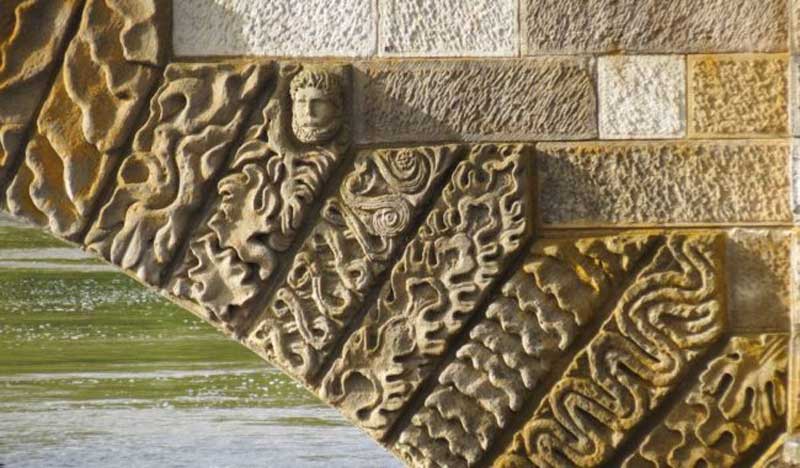
Self portrait carving of Daniel Herbert on Ross Bridge
There are 186 icons, one on each of the voussoirs forming the six arches of the bridge, There are 186 carvings in all, 31 over the top of each arch. Many are not directly representational but give impressions of rural activity with stylised wool bales and wheat sheaves. On the key-stones, and elsewhere also, are depictions of animal and human figures. Celtic-derived carvings are interspersed with small icons believed to be of persons living at the time. The theme, according to a 1971 study, is consistently oppression and death opposed by rebirth and renewal.
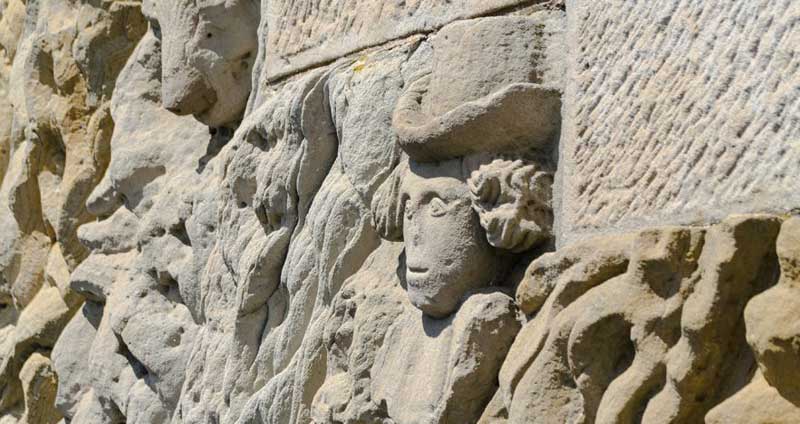
Carving of Lt. Governor George Arthur
The people depicted are said to include Lt. Governor George Arthur (25th voussoir on the right arch on the northern face), caricatured in his top hat atop a skull, redolent of the suffering he presided over; the sixteenth century protestant, John Calvin, the Puritan inspiration for Arthur's stern rule; John Headlam, the hated Hobart schoolmaster, identified by his mortar board, who became the largest landholder in Tasmania; William Kermode, a grazier prominent in local affairs; and a Tasmanian aborigine.
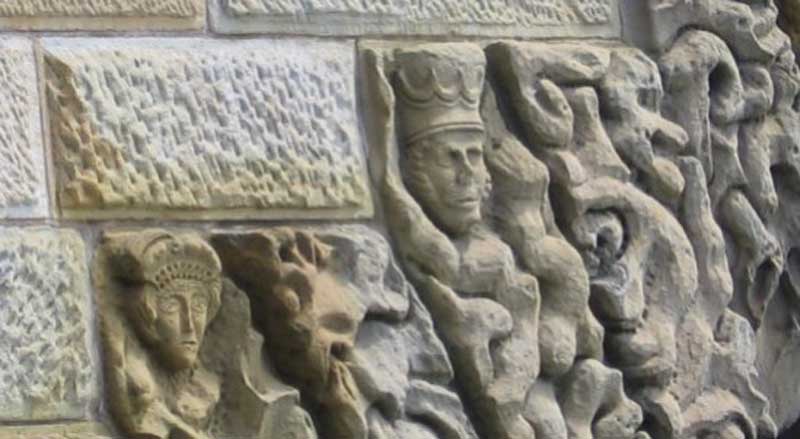
Carvings of Norah Cobbett and Jorgen Jorgenson
The face generally called The Queen (7th voussoir from the left of the first arch of the northern face) has been identified as Norah Cobbett, the alcoholic wife of Danish adventurer Jorgen Jorgenson - a king-like face adorning a keystone arch might well be his (9th voussoir from the left of the first arch of the northern face). Herbert surrounded Norah Cobbett with androgynous healing symbols, as if to counteract the violence and misery of her short life.
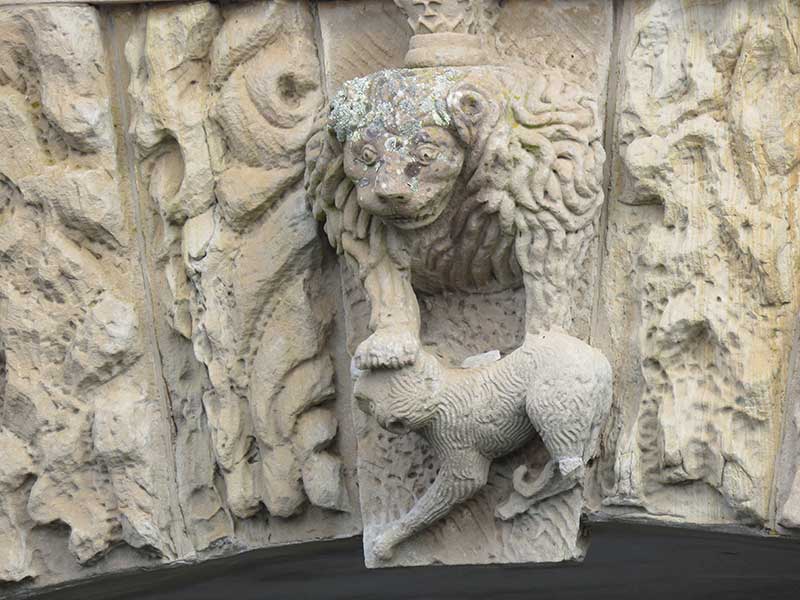
The keystone on the north-west arch is a distorted lion (Britain?) wearing a crown and gripping a lamb in its claws. A stag with a hominid mask between its antlers seems to show the Celtic god Cernunnos in regenerative aspect. Dogs, linked with death and resurrection, appear four times, one with a Celtic horn. Herbert even included himself (25th voussoir on the middle arch on the southern face) and his wife (25th voussoir on the left arch on the northern face) - he married convict maidservant Mary Witherington during construction - surrounded by unity and healing motifs.
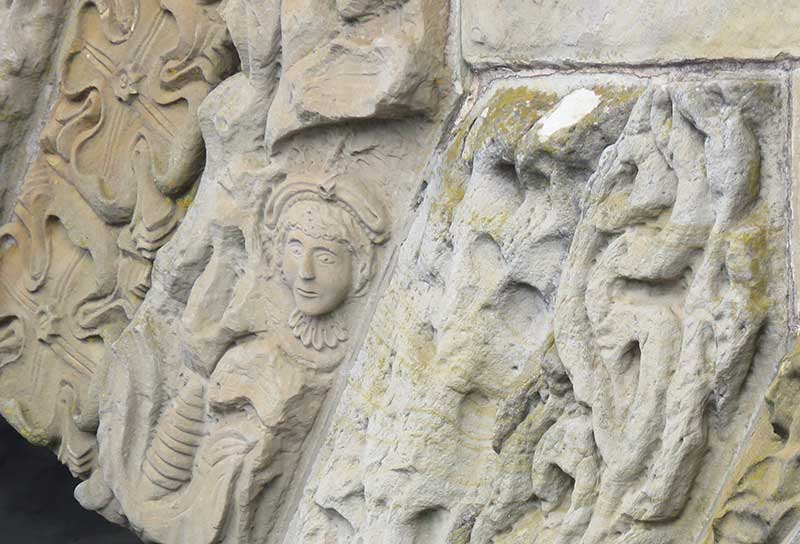
Carving of Mary Witherington
Why they are there is a mystery as they should not exist at all. Convict buildings of the era were designed and constructed for functionality, and not for decoration. Construction of the bridge had been delayed a number of times, so it is hardly likely the athorities would have been happy for time to be wasted adding such unneccessary embellishments. Herbert must have gained prior permission to sculpt them, and this permission must have been granted, at least verbally.
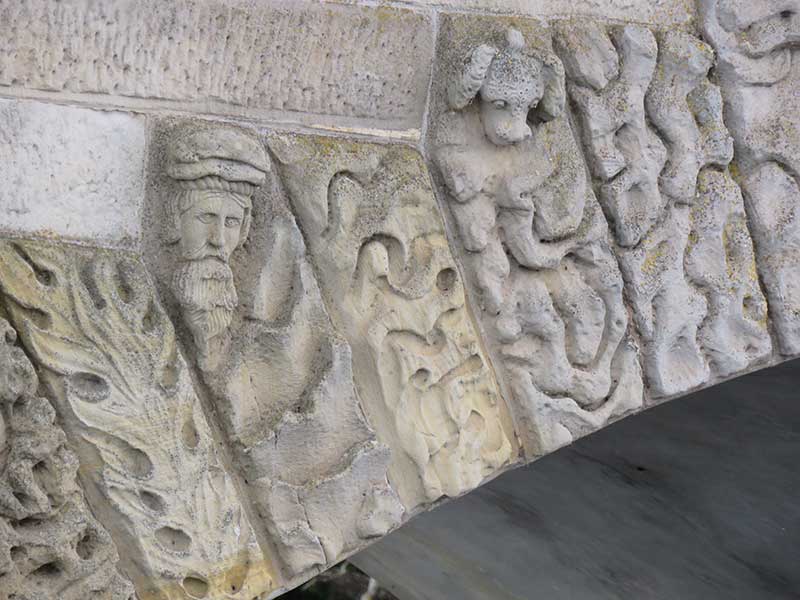
Carving of John Calvin
John Lee Archer must have seen this work in progress during one of his site visits, and it is unthinkable that he would not have known about them, yet his diary appears to be silent on the subject. The same applies to Roderick O'Connor, the Inspector of Works, and Charles Atkinson, the project architect, a recent arrival from England. Atkinson was dismissed in 1835 though stayed on in Ross to continue work on St John's Church of England. He was replaced by William Turner in June 1835, as the project supervisor.
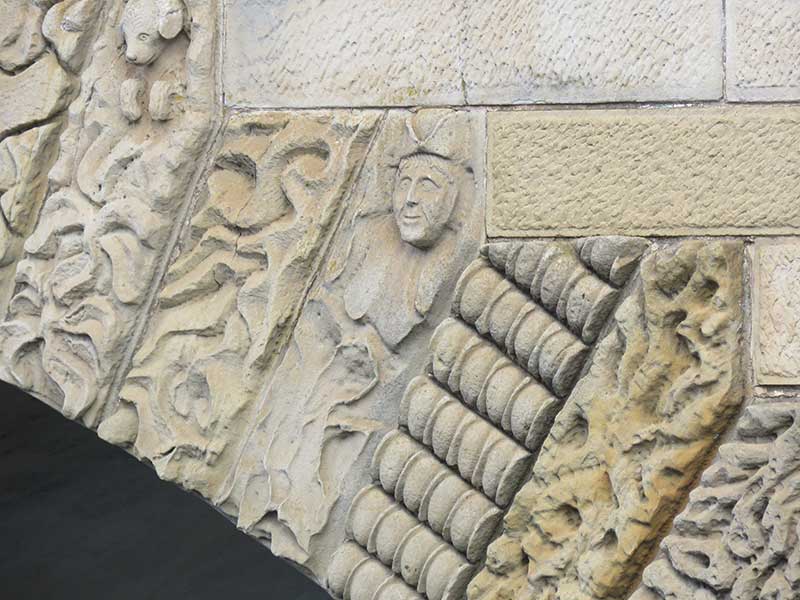
Carving of William Kermode
Sculpting these stones could not have been done in secret. One may postulate that Capt. Turner, having given Herbert permission to do this work, led a conspiracy of silence, by explaining to all concerned that the carving of these stones was the convicts' contribution to the appearance of the bridge and was improving morale, and thus efficiency and standard of workmanship. If so, the innovation of decorating the Ross Bridge with carvings should have been a celebration, trumpeted as a fine creative legacy, but instead the work proceeded under a cloak of silence.
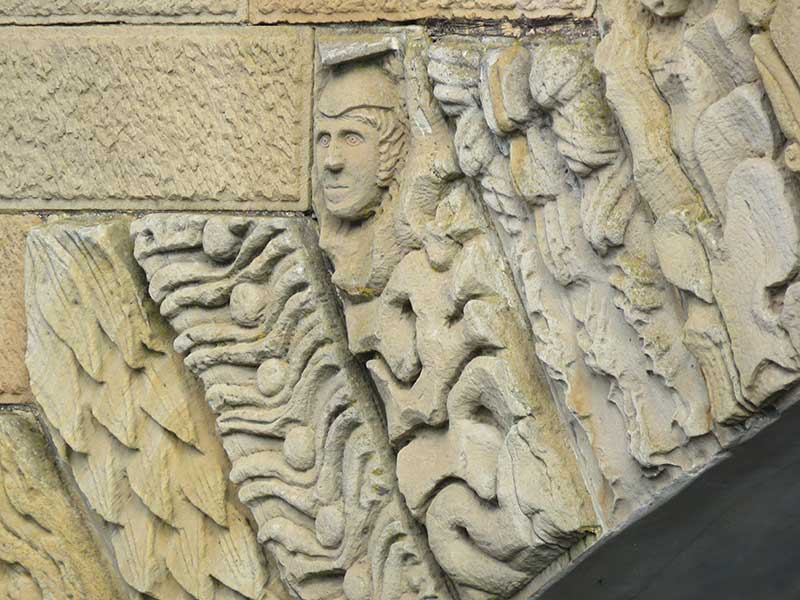
Carving of Hobart Schoolmaster, John Headlam
Many of the keystone's symbols appear to be representations of the evils of oppression, which supports a general view, shared by many in the Ross community, that these carvings form an integral part of the construction of this bridge - that they originated as a vision of a convict sculptor, who convinced his fellow convicts that the production of these sculptures somehow reaffirmed their humanity, be it at the cost of a considerable amount of hard work. On this basis, it is said the sculptures most certainly must be considered as an integral an important part of the bridge, and not a mere embellishment.
Others have a different point of view. Celtic-derived carvings can be found on a few buildings around southern Tasmania that Herbert worked on. To suggest his work reveals a pagan belief system is to draw a very long bow. At the very least, Herbert could be said to have been exorcising the demons of his transportation, but more likely it was an outburst of religious and political subversion, an unspoken expression of displeasure towards an unfair society (he had been trasported to Van Diemen's Land for highway brobbery), the cruelty of the British colonial penal system (he had been flogged a number of times for being drunk) and perhaps even Calvinist Christianity, which numerous of the bridge's celtic symbols seem to be mocking. This intrepretation of the meaning of the carvings is explained in the video below. Either way, the daring and subtle paganism, rebellion and satire that so dominates Herbert's work appears to have eluded his contemporaries.
Fellow convict stone mason and bridge builder, James Colbeck, had every reason to be a willing participant in the plot to bury an anti-establishment protest in the bridge's decorative artwork. Colbeck had worked on Buckingham Palace in London for three years. Newly married and with a young son, Colbeck grew tired of living apart from his wife and child, and returned to his hometown of Dewsbury. Unable to find work in the area and desperate to feed his starving family, Colbeck resortedv to burglary. He was sentenced to transportation for life to Van Diemen's Land, arriving in Hobart in November 1828.
Colbeck was one of the original convicts assigned to build the bridge in 1833. Since it was made of timbers, there was little work for him. However, he worked for William Kermode who was busy building a house in the neighbourhood. Colbeck's earnings were banked by Kermode, whose son Robert Quale was going to arrange Colbeack's passage back as soon as he got to England. It was against the rules for a convict like Colbeck to engage in paid work, so as punishment Colbeck was sent to Hobart to "reform his ways". It was there that he met Herbert, working alongside him on the new Customs House before he was dispatched back to Ross with Herbert in May 1835 to build the Ross Bridge.
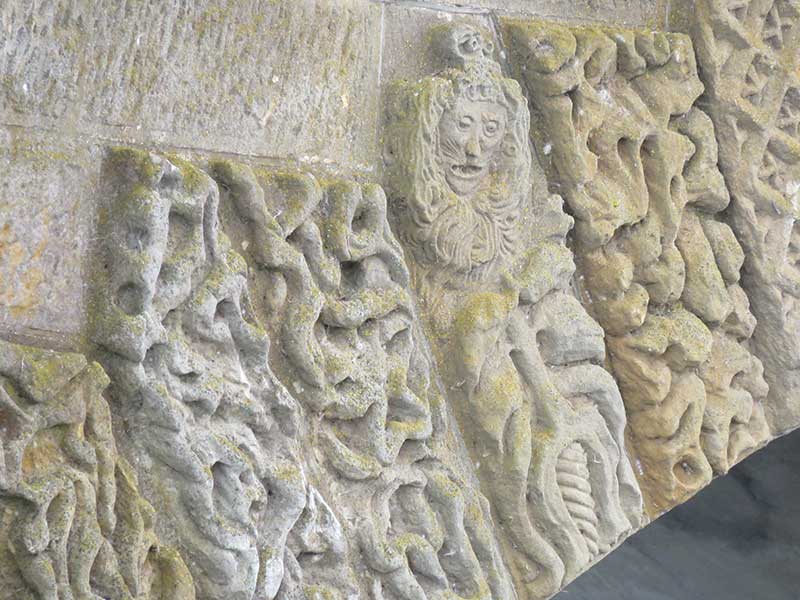
Although given detailed instructions from the government appointed architect, Charles Atkinson, Colbeck ignored them. Atkinson stated: "Is it possible for an ignorant unlettered plodding scion of his class to understand the construction of the most difficult and scientific structures invented by man?" Judging by the way the bridge he built has stood the test of time, the answer to Atkinson's question in this case is a resounding "yes".
Colbeck and Daniel Herbert received their emancipation on the completion of the bridge. Colbeck received a Free Pardon on 28 October 1841, and eventually returned to England and the town of his birth, Dewesbury, Yorkshire, and started a new life - using the wages he had earned working for William Kermode that had banked in England for him. He remarried in 1850 but died in Dewsbury two years later, age 51.
The reason for the decorative stones is but one of two unsolved mysteries lingering on from the convict era that have a connection to the Ross Bridge, and therein might lie the answer to this puzzling question. There were two convicts dispatched to Van Diemen's Land, who both only just escaped the hangman's noose in England, whose lives became entwined by the building of Ross Bridge. One was the former ruler of Iceland, the Danish adventurer Jorgen Jorgenson and the other, Daniel Herbert. Jorgenson's crime was remaining in England after he had been ordered to leave the country. Herbert's was highway robbery and he was as lucky to get away with his life by being transported to Van Diemen's Land as we are to be able to enjoy the unusual legacy in stone he left behind.
Afer his emancipation and couple of years before work on the bridge began, Jorgenson had found success in the Van Diemen's Land Field Police, when he broke up a gang of sheep rustlers. Consequently he was sent by the Colonial Governor George Arthur to Ross in 1833 to find out why the convicts he had sent to Ross to build the bridge hadn't started work on it. Upon his arrival Jorgenson was greeted by a wall of silence and lots of nice, new stone houses - it seems the folks ar Ross had used the free convict labour and stone for the bridge to develop their properties rather than build the bridge. In May 1835, George Arthur sent someone else to Ross - convict Daniel Herbert, who was overseer of the the building of the new Customs House in Hobart. He and fellow convict James Colbeck were given the task of building the Ross Bridge by the Governor and promised emancipation upon completion of it.
Jorgenson was a regular visitor to Ross and it is likely he and Herbert would have discussed the bridge and its construction because of their common interest in seeing it completed. A former convict himself, Jorgenson was a writer and avid walker whose medical skills would have been in demand among the convict classes. Having been the ruler of Iceland for three months, a world traveller, taken a three month soujourn in Tahiti, and sailed round the Horn, Jorgenson had a wonderful story to tell and is renowned for having travelled the length and breadth of Van Diemen's Land sharing his adventures and exploits with anyone who would listen.
The exiled King might well have captured the imagination of the humble stonemason with his tales of glory and conquest, inspiring Herbert to use Jorgenson and his lost kingdom as the subject of the bridge's decorative art. But more likely is that their shared distain for a system and society that had spat them out led them to conspire to add the mysterious carvings to their bridge.
Perhaps it was the intervention of the self-styled "King of Tasmania" that allowed Herbert to carve his subversive protest all over the bridge, right under the authority's noses, without them even realising what his handiwork meant. There is a stone carving of what appears to be a king on the bridge; it is more portrait-like than any of the other carved heads, and is believed to represent Jorgenson. They were both rebels from another age, and one wonders if the crossing of their similar paths at the isolated colonial outpost of Ross might be the key to unlocking the mystery of the Ross Bridge carvings.
View Larger Map
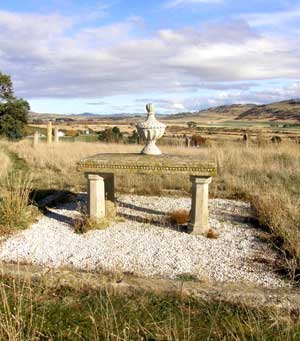
Stonemason Daniel Herbert's grave in the Ross cemetery
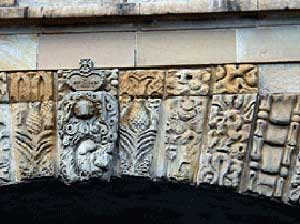
Ross Bridge carvings
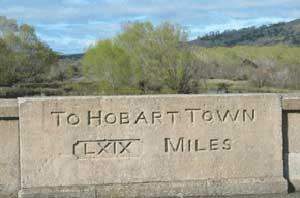
Milestone on the bridge
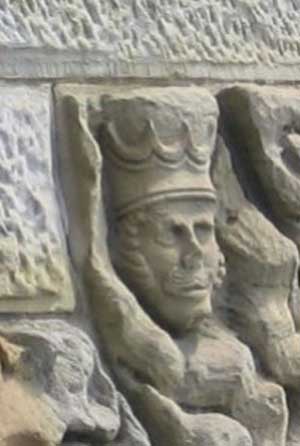
'King' Jorgenson?